 October 10, 2026 · 14 min read · by Slava
Baseboard heater replacement, the way I do it, means taking a worn electric baseboard heater off the wall and mounting a new one in the same spot, on the existing circuit. My labor price for the swap is $150–250, and the heater itself is a separate material cost. You send photos, the exact price comes back the same day, and it does not change once I start.
Here is what I do and what I don’t. Electric units on wiring that is already in the wall are my work. Hot-water baseboard tied to a boiler, new circuits, and moving a heater to a bare wall are not. Below is the full job in order: the photo estimate, removal, wall repair, the new heater, the price list and booking in Northeast Philadelphia.
Key takeaways: the job in five lines
- I replace electric baseboard heaters on the existing circuit only.
- Hot-water (hydronic) baseboard and boilers are a licensed trade, not mine.
- The price comes from your photos, is fixed in writing, and covers labor only.
- The wall behind the old unit is the cheapest place to patch and paint while it’s open.
- Workmanship carries a one-year warranty, and I clean up before I leave.
When an Old Baseboard Heater Is Worth Replacing
An old baseboard heater is worth replacing when the housing, end caps or heating performance have worn past what cleaning can fix. Can you replace old baseboard heaters? Yes. I swap electric ones for a new electric baseboard heater on the same wall and the same wiring, so the room keeps its heat and the circuit stays as it is.
The signs are usually easy to see and smell:
- a bent, dented or rusted housing, often along the bottom edge near the floor;
- uneven heat, with one end warm and the other barely working;
- a burnt-dust smell that comes back every time the heat kicks on;
- cracked or missing end caps that leave the wiring compartment exposed;
- a yellowed, scuffed unit that looks out of place once a room has been repainted.
Replacing a baseboard heater is not always the right answer. If the element heats evenly and only the outside looks tired, heater covers and cleaning may be enough. I do covers and cleaning myself, so if your element is fine, I’ll say so from the photos instead of selling you a full baseboard heater replacement. Homeowners save money that way, and the heater on the wall keeps doing its job.
What I Replace and What Belongs to Another Trade
I replace electric baseboard heaters on the existing circuit. Anything that runs on water, needs new wiring, or means moving the heater is outside my work. That line is worth drawing before you book, so nobody schedules the wrong visit.
Mine: an electric unit swapped on the wiring that is already there, plus covers and cleaning under my Baseboard Heat service. Not mine: gas lines, boilers, hydronic heating, hot-water heating — a licensed trade, not mine. The same goes for a new circuit, a new breaker, panel work, or moving a heater to a wall with no wiring. If the job needs any of that, I tell you plainly and send you to a licensed pro instead of improvising.
If you’re asking about hot water baseboard heater replacement or replacing hot water baseboard heaters, first check which system you actually have:
- Electric baseboard: a wire connection box at one end, no pipes going into the wall or floor. I do this.
- Hot-water or hydronic baseboard: copper pipe running through aluminum fins, connected to a boiler somewhere in the house. That is a licensed trade.
If you need to replace a hot water baseboard heater, a hydronic specialist is the right call. Any replacement for baseboard heaters that runs on water belongs with them.
Step 1: A Photo First, Then a Fixed Price
Every heater swap starts with your photos, not a visit. Send a photo of the job and the price comes back the same day. On the phone I can only give a range. The exact number comes from the photo estimate, and A fixed price in writing before I start.
What to photograph before you text me:
- the whole heater, end to end, so I can judge its length;
- the label on the end of the unit, which lists wattage and voltage;
- the wall thermostat or the built-in knob on the heater;
- the wall under and around the heater, including the floor line.
The label matters most when you change baseboard heater units. The new electric baseboard heater has to match the voltage of the old one and stay close in wattage, so it runs on the same wiring without changes. That’s what keeps changing baseboard heaters a swap and not a rewiring job.
I don’t haggle and I don’t cut prices. I’d rather turn a job down than lower the price and then cut corners on the work. Details are on my price from a photo page.
Step 2: Power Off and the Old Heater Comes Out
The old baseboard heater comes out only after the power is off at the breaker and confirmed dead at the heater itself. Baseboard units usually run on 240V, though some are 120V. Either way, the wires get tested before anyone touches them.
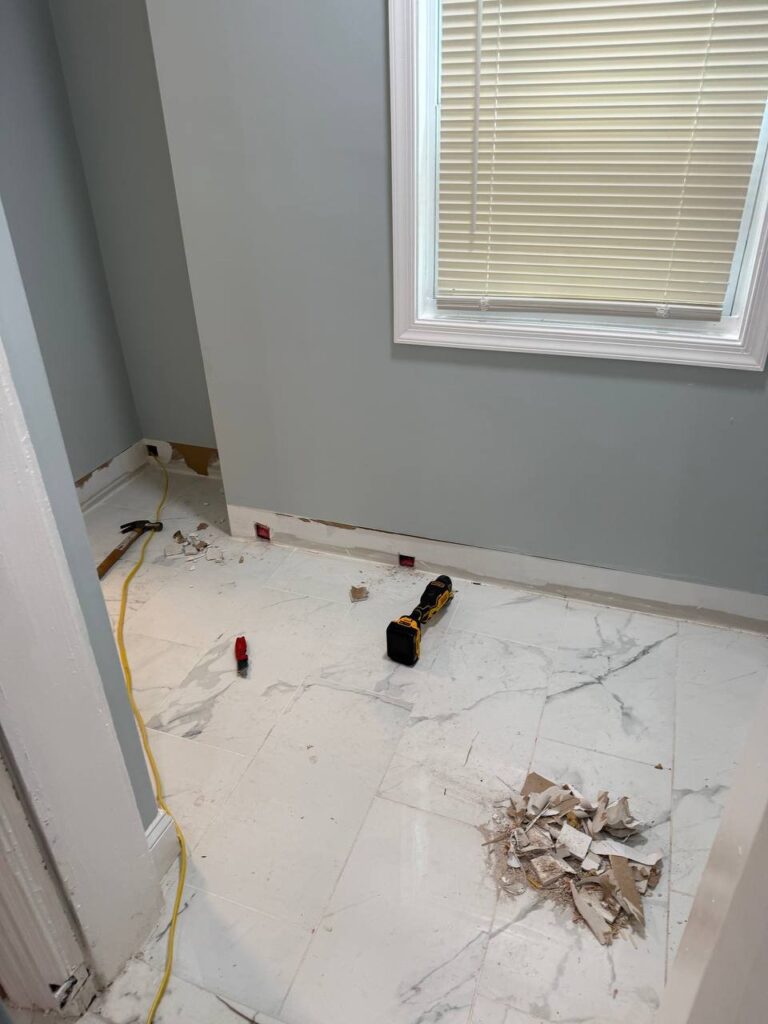
This old unit came off the wall under a window partway through one of my jobs, and the sequence was the same as on any swap of this kind. The breaker went off and I checked for voltage with a tester at the heater. Then the cover came off the wiring compartment, and I labeled each wire before disconnecting it. With the mounting screws out, the heater lifted free of the wall.
What sits behind an old baseboard heater rarely matches the rest of the room. Expect dust lines where air moved along the wall for years, a strip of wall that was never painted because the unit covered it, and old screw holes. Sometimes there is loose plaster or crumbling drywall near the floor.
Before anything new goes on, I look closely at the wire ends coming out of the wall. Replacing baseboard heat only works if those ends are sound. If they are scorched, brittle or too short, or if the wiring has to be moved, I stop there. Changing baseboard heating wiring is a licensed trade, and I say so instead of working around it. The existing circuit gets checked before the new heater goes on, not after.
Step 3: Fixing the Wall Behind the Heater
The best time to repair the wall behind a baseboard heater is while the heater is off it. Once the new unit is mounted, that strip is hidden again and much harder to reach. Patching now costs less than taking the heater back down later.
The work is ordinary wall repair, done properly. Old holes get filled, damaged drywall or plaster gets cut back and patched, and the surface is sanded flat. Then it gets touched up or repainted so the color under the new heater matches the wall above it.
Old holes almost always need filling. A new heater may be a different length than the old one or have its mounting points in different places, so the original holes end up exposed beside or above the new unit. Good baseboard heating installation starts with a solid, flat wall for the screws to bite into.
This is its own work under Drywall & Plaster and Painting & Touch-ups, priced separately from the heater. A drywall patch runs $100–150 depending on the size and number of spots. If the whole room is due, painting a room is $300–450, with paint separate.
Step 4: The New Heater Goes On the Existing Circuit
The replacement baseboard heater goes on the same wall and connects to the existing circuit, matched to the voltage that’s already in the wall. Nothing about the feed changes. Only the unit does.
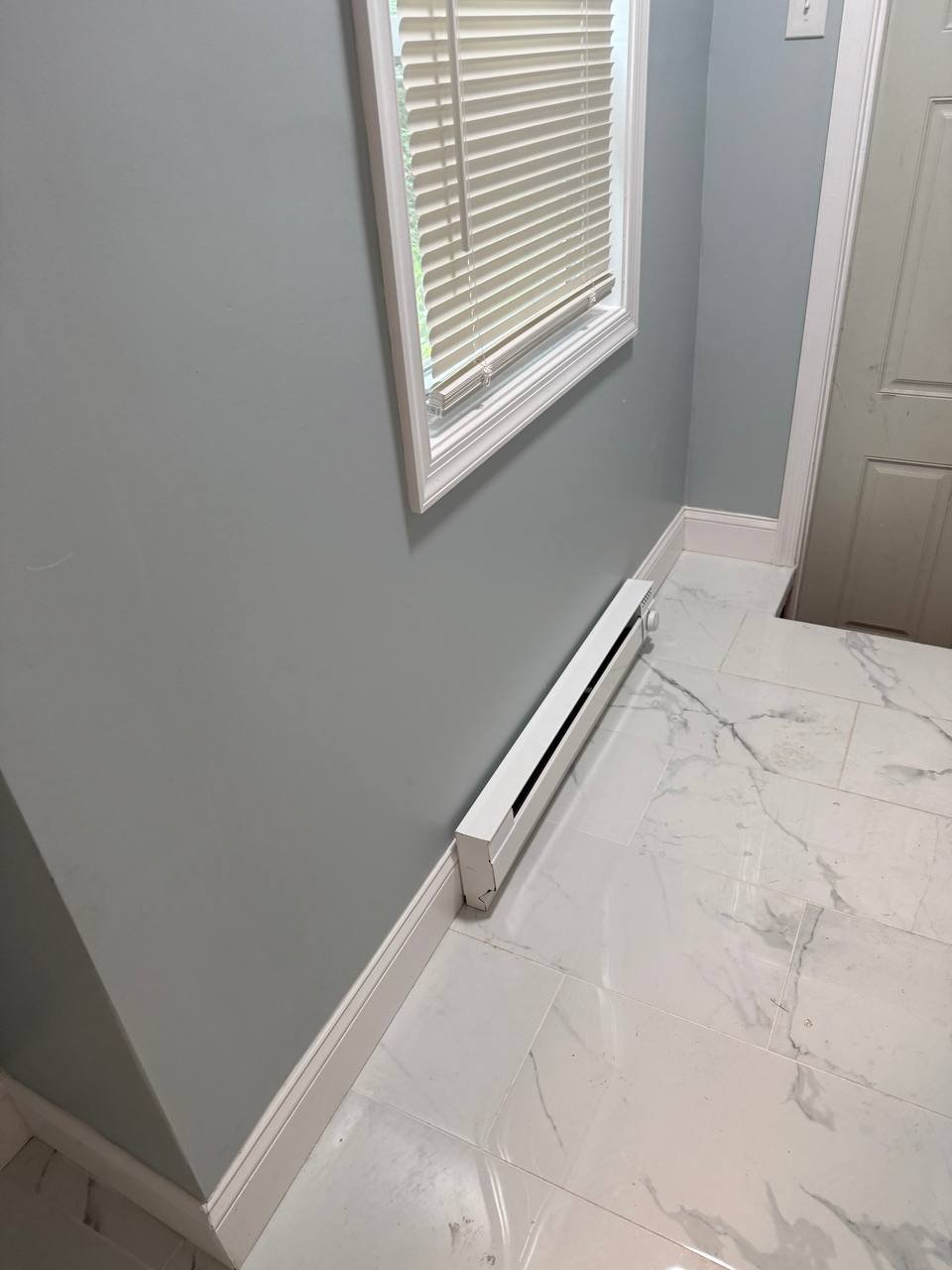
On this job, a new white baseboard heater went onto the wall under the window as the finished part of the work. It was leveled first, then fastened into studs where they fell, with proper anchors where they didn’t. The wires were joined to the existing feed and the wiring compartment cover went back on. Then the breaker came back on and I ran the heat to confirm the whole length warms up.
Placement is part of doing it right. The heater needs clearance from the floor so air can move under it, and curtains shouldn’t hang into or drape over it. Keep sofas, beds and dressers off the front of the unit too. Blocked air means uneven heat and dust cooking on the element.
Modern baseboard heaters change a few things you’ll notice day to day:
- cleaner housings that are easier to wipe down;
- tighter end caps that keep fingers and dust out of the wiring compartment;
- simpler built-in thermostat options on many models.
Replacement baseboard heaters still have to match the voltage already in the wall. I connect the heater to the existing feed. I don’t rewire thermostats or add a thermostat circuit.
When It’s Time to Call a Different Pro
It’s time for a different pro when the job is no longer a swap on the existing circuit. These situations fall outside my work:
- adding baseboard heaters where there were none before;
- needing more heat than the current wiring can carry;
- scorched, brittle or damaged wires at the heater;
- a breaker that keeps tripping;
- any hot-water baseboard or boiler problem.
If you’re looking up how to add baseboard heaters, the honest answer is that adding a heater means a new circuit, and a new circuit is a licensed trade, not mine. I don’t offer steps for it and I don’t attempt it. When I see that a job needs wiring or pipes, I say so and send you to a licensed pro instead of trying to get around it.
What Baseboard Heater Replacement Costs With Me
Baseboard heater replacement costs $150–250 in labor with me. That’s my own price list, not an industry average, and I can’t speak for anyone else’s numbers. Prices are for labor — materials and hardware are separate.
| Work (labor only) | Price |
|---|---|
| Baseboard electric heater | $150–250 |
| Minimum service call | $75 |
| Custom work, hourly | $85/hour |
| Drywall patch | $100–150 |
The minimum service call is $75. The hourly rate applies when the scope isn’t clear yet, for example when a heater has to be looked at in person before anyone can say what the job really is.
For baseboard heater replacement in Philadelphia, these things move the cost within the range:
- the length of the unit;
- how many heaters are being swapped on the same visit;
- the condition of the wall behind the old heater;
- whether the old mounting is painted over, rusted or has to be cut free.
The heater is a material and is billed separately. The full price list is on my pricing page.
Who Buys the Heater and How the Visit Goes
Homeowners usually buy the heater themselves, so they get the model and look they want. Match the voltage on the old unit’s label and keep the wattage close. That answers where to find replacement electric baseboard heaters: any supplier you like, as long as the label matches. If you’d rather not shop, I can buy the electric baseboard heater on a receipt with a small purchasing markup, shown as a separate line in the estimate.
The visit itself is simple. Clear the furniture along that wall before I arrive. One craftsman from the first measurement to the clean-up — no call center, no subcontractor you have never met. I finish the job and clean up before I leave, because clean-up is part of the work, not a favor. From a Google review by Yuliia Khmil, about a TV I mounted for her: “he cleaned up after the work was finished.”
Payment comes after the work, by cash, Zelle, check or card, with no deposit on regular jobs. Workmanship is warranted for one year from completion. If it isn’t right afterwards, I come back and make it right, free.
Put the Heater on a List With Other Small Jobs
A heater swap is a good reason to put other small jobs on the same visit. The minimum call is the same no matter how small one task is, so a list makes each item go further. Small jobs are welcome — they go faster and cheaper as one list in one visit.
A second heater, a new cover, a shelf or mirror, a door that sticks, or furniture through Furniture Assembly all fit easily into the same trip.
A TV on the wall is the natural add-on when the heater sits in the living room. With TV & Picture Mounting, the wall decides the price more than the screen size, so I ask about the wall first. In older rowhomes it’s often brick or plaster rather than drywall, which means different hardware and more time. If the heater wall needs Painting & Touch-ups anyway, it makes sense to plan the TV wall in the same visit.
Booking Baseboard Heater Replacement in Northeast Philadelphia
You can book baseboard heater replacement by calling or texting me with photos of the heater. Most of my work is in Northeast Philadelphia and the neighborhoods around it. My base is in Bustleton, and I work regularly in Somerton, Rhawnhurst, Fox Chase and Mayfair. I also travel to Bucks, Montgomery and Delaware County.
Hours are Mon–Sat 7 AM – 7 PM and Sunday 8 AM – 5 PM. Monday to Saturday the last booking starts at 6 PM for people who get home after work.
If you’re searching for baseboard heater replacement in Philadelphia near me, or for the best baseboard heater replacement in Philadelphia, compare the basics: a fixed written price, a clear line on what the person does and doesn’t do, and a warranty. Insured. City of Philadelphia Commercial Activity License #1012177. Rated 5.0 on Google from 12 reviews. Details are on the Baseboard Heat page.
Call or text (267) 679-8533.
FAQ
-
What is the average cost to replace a baseboard heater?
I can’t speak for an average, but I can give my own price: $150–250 for labor to swap an electric baseboard heater on the existing circuit. The heater itself is a separate material cost. Send photos of the unit, its label and the wall, and the exact fixed price comes back the same day.
-
Can you replace old baseboard heaters?
Yes, electric ones. I take the old unit off, check the wire ends, repair the wall if it needs it, and mount the new heater on the same wiring. If the wiring has to change, or the heater is a hot-water type tied to a boiler, that’s a licensed trade, not mine, and I’ll tell you so.
-
Where can I get free heater repairs in Philadelphia?
I don’t do free repairs and I don’t keep a list of programs. What I offer is a price from a photo, a fixed labor price before I start, and a one-year workmanship warranty on the job. Boilers and hot-water heating are a licensed trade, not mine, so those need a hydronic specialist.
-
Where can I find replacement electric baseboard heaters?
Homeowners usually buy the heater themselves so they can choose the model they like. Match the voltage on the old unit’s label and keep the wattage close to it. If you’d rather not shop, I buy the heater on a receipt with a small purchasing markup, listed as a separate line in the estimate.
-
Do you replace hot water baseboard heaters?
No. Hot-water (hydronic) baseboard runs off a boiler, and that’s a licensed trade, not mine. I work on electric baseboard heaters, their covers and cleaning. Not sure which you have? Copper pipes and fins mean hot-water. A wire connection box at one end and no pipes means electric.
-
Can the new heater be a different size than the old one?
Often yes, as long as it runs on the same voltage and its wattage fits the existing circuit. A different length usually leaves old screw holes and an unpainted strip of wall exposed. That’s the moment to patch and touch up, while the heater is still off the wall and the area is easy to reach.
-
Can you add a baseboard heater to a room that doesn’t have one?
Adding a heater means running a new circuit, and new circuits are a licensed trade, not mine. I replace heaters on wiring that is already in the wall. If there is existing heater wiring in that room, send me a photo and I’ll tell you honestly whether the job is a straight swap.
-
Is it worth just cleaning or replacing the cover instead?
Sometimes, yes. If the element heats evenly along its whole length and only the housing is dented, scuffed or dusty, a cleaning or a new cover may be enough. I do covers and cleaning myself, and I’ll say so from your photos rather than sell you a full heater replacement.