 October 18, 2026 · 11 min read · by Slava
IKEA furniture assembly with TonyFix Handyman works like this: one handyman comes to your home and builds your flat-pack pieces. The tall ones get anchored to the wall, and the room is cleaned up before I leave. You pay a fixed labor price per piece, and you know that price before I start. The full price list is in the next section.
I assemble IKEA and other flat-pack furniture:
- PAX-size wardrobes and dressers
- Bed frames and desks
- TV stands and dining tables
- Bookcases and kitchen cabinet units
If it arrived in a box with a hardware bag and an instruction sheet, I can put it together. That goes for a single bookcase or a whole bedroom delivered at once. The overview of the service is on my furniture assembly page. This article covers the practical side of getting IKEA put together right: what each piece costs in labor and where the time actually goes.
Most of my work is in Northeast Philadelphia and the neighborhoods around it. Below you’ll find the per-piece table. After that come the craft details: wall anchoring, drawers, beds, cabinets, and what I need from you before the visit.
Flat-Pack Assembly Prices, Per Piece, Labor Only
My IKEA assembly service is priced per piece, for labor only. These are the ranges:
| Piece | Labor price |
|---|---|
| Bookcase or kitchen cabinet | $80–120 per unit |
| Dining table | $90–150 |
| Desk or TV stand | $100–150 |
| Bed frame | $110–160 |
| Dresser | $130–200 |
| Wardrobe, PAX-size | $200–300, anchoring to the wall included |
Prices are for labor — materials and hardware are separate.
Three things move a piece up or down within its range:
- Size. A tall, wide case means more panels and more fasteners. It also means more care when it’s stood upright.
- Drawers and doors. Every drawer has runners to set. Every door has hinges to adjust.
- Anchoring. A piece that has to be fixed to the wall takes extra work. The wall type decides which fastener is used.
By phone I give only the range. The exact number comes from a photo. Send a photo of the job and the price comes back the same day. Once I’ve given that price, I don’t change it during the job. A fixed price in writing before I start. You can read how this works on the price from a photo page. The rest of my services are listed on the pricing page.
From a Floor Full of Boxes to Finished Furniture
Good assembly of IKEA furniture is decided before the first screw goes in. It depends on how the parts are laid out, sorted, and checked against the instruction sheet. A build that starts organized ends square. A build that starts from a heap of loose panels tends to end with a leftover bolt and a door that won’t close.
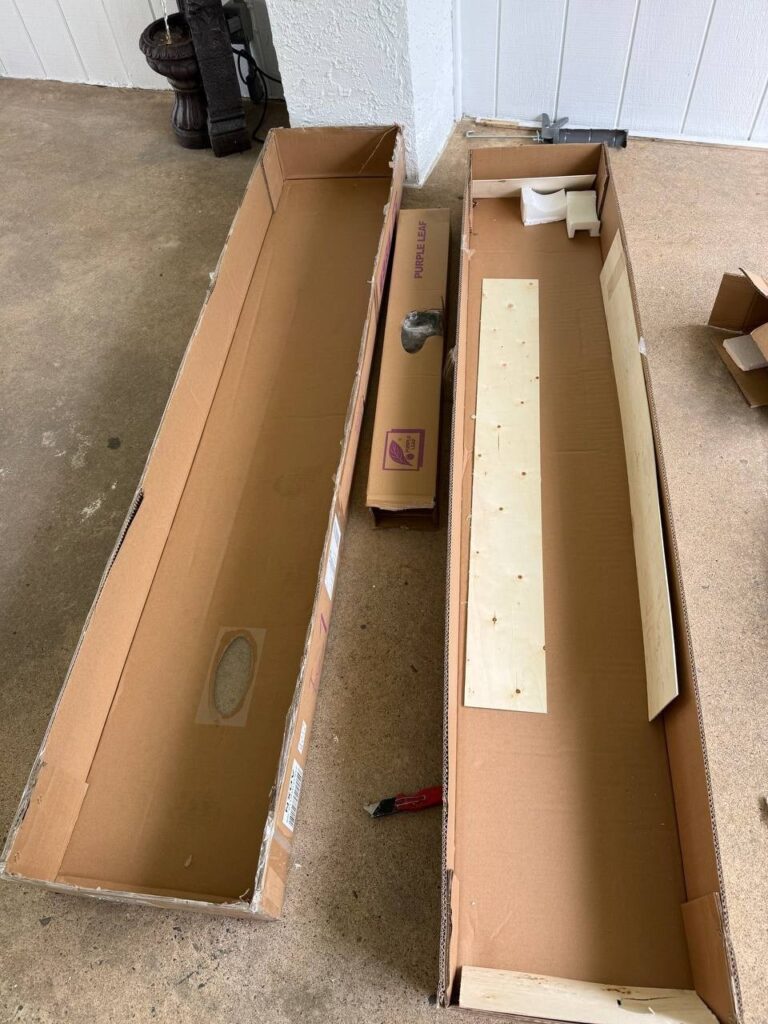
Here the cardboard is open and the parts are out on the floor: this is one of my jobs in progress, at the stage where the boxes have become panels and hardware. On a flat-pack job like this, the panels are grouped by the part numbers on the instruction sheet. The hardware bags are opened and counted against the parts list before anything is joined. A missing cam or a wrong-length screw is easy to catch at this point and expensive to discover halfway up a frame.
Three details separate furniture that lasts from furniture that wobbles:
- Cam locks and dowels. They have to seat fully. A cam turned half a turn short leaves a joint that loosens the first time the piece is moved.
- Back panels. They hold the case square, so the case is checked for square before the back goes on. A back fixed to a racked frame locks the twist in.
- Drawer runners. They must be level and parallel, or the drawer rubs, sticks, or won’t close flush.
I come myself and finish the job myself. Before I leave, I clean up. That’s part of the work, not a favor.
PAX Wardrobes and Anchoring Tall Furniture to the Wall
A PAX-size wardrobe or a tall dresser should be anchored to the wall. A top-heavy case can tip forward when a loaded drawer is pulled out or a child climbs it. Anchoring is included in the PAX-size wardrobe price.
Several craft points matter on any tall piece:
- Build on its back, then stand it up. The frame is assembled lying down. Tipping a tall frame upright needs more room than its standing height, because the corner sweeps an arc on the way up. So ceiling clearance gets checked before the first panel is joined, not after.
- Level it on uneven floors. If the case isn’t level, the doors won’t meet evenly and hinges won’t hold their adjustment.
- Doors and hinges last. Doors go on after the frame is standing, level, and anchored. Then the hinges are adjusted so the gaps run even top to bottom.
Anchoring depends on the wall. In older rowhomes the wall is often brick or plaster, not drywall. That takes different fasteners than the anchor that comes in the box. That’s why I ask about the wall before I name a number.
How the load travels:
- Wardrobe top rail → anti-tip strap or bracket → fastener chosen by wall type
- Drywall → screw into a stud
- Plaster → fastener suited to plaster, reaching solid backing behind it
- Brick → masonry anchor in a drilled hole
Beds, Dressers, Desks and Dining Tables: Where the Time Goes
On beds, dressers, desks and dining tables, the time goes into the parts that move or carry weight. Panels joining panels is the quick part.
- Dressers. Most of the work is the drawers. Each drawer box is built and checked for square. Then its runners are set so that every drawer in the stack closes flush and none of them rub. One runner set slightly off shows up as a drawer front that sits proud of its neighbors.
- Bed frames. The slats and center supports take the load, so the center support has to touch the floor firmly. In a tight bedroom, space is the other issue. The frame often has to be built in place, because there’s no room to assemble it elsewhere and carry it in.
- Desks. Cable trays, drawers, and keyboard shelves add steps. A desk also needs to be checked for wobble once it’s standing, because it gets leaned on every day.
- TV stands. This is furniture only: the case, the shelves, the doors or drawers, and a level top.
- Dining tables. A table that rocks usually has legs that aren’t square to the top. The fix is to square the legs and snug the bolts in sequence, not to wedge a folded napkin under one foot.
One client review on Google, from VIP AutoFlow:
I couldn’t be happier with the work! Everything was done professionally, with great attention to detail, and the finished result looks amazing. The floating shelves and desk were installed perfectly.
Kitchen Cabinets and Bookcases: What I Take On and What I Don’t
Kitchen cabinets and bookcases are priced per unit. I assemble the units themselves. That means the carcass, shelves, doors, drawers, and hinge adjustment, built square so the doors line up. A tall bookcase gets the same treatment as a wardrobe: back panel on a square frame, then anchored to the wall with a fastener chosen for that wall.
Turnkey kitchens are not my work. I don’t take on a whole kitchen as a project, and I don’t price one. Some parts of a kitchen are a licensed trade, not mine:
- New wiring
- Pipes inside the walls, risers, and drains
My part on the plumbing side is visible plumbing and the fixture itself. Faucets and toilets are swapped on the existing supply lines. If a cabinet job turns out to need work inside the wall, I’ll say so plainly and send you to the right trade rather than improvise.
Read this before you call. A handful of cabinet units assembled and ready? That’s a job I take. A full kitchen from bare walls? That’s a different kind of project, and it isn’t mine.
Is It Worth Paying for IKEA Assembly?
Paying for IKEA assembly is worth it for some pieces and not for others. A small bookcase or a simple side table is often something you can build yourself in an evening. It has few parts, no drawers, and nothing that hangs on the wall. If you have the time and a screwdriver, that’s a fair choice, and I’d rather say so than pretend every box needs a pro.
Paying makes sense where the work gets harder to get right:
- Size and weight. A PAX-size wardrobe has to be stood up safely, often in a room with limited ceiling clearance.
- Drawer alignment. A dresser has a stack of runners that all need to agree.
- Door adjustment. Hinges have to be set so the gaps run even and doors close cleanly.
- Wall anchoring. Brick or plaster calls for different fasteners than the ones in the box.
- Several pieces at once. A bed, a dresser, and a wardrobe for a whole bedroom add up.
With labor-only pricing and a fixed number from a photo, you can weigh it before you commit. Send the photo, see the price, and decide which pieces you’d rather build yourself and which you’d rather hand off. Both answers are reasonable.
What I Need From You Before the Visit
Before the visit, I need a photo of the boxes or the product labels and a photo of the room where the furniture will stand. That’s enough for an exact assembly price. If anything goes on the wall, add a note on what the wall is: drywall, plaster, or brick. If you’re not sure, a close photo of the wall helps.
The furniture and its hardware are usually yours. You choose and order the pieces you want, and I build them. Sometimes something has to be bought, like a different wall anchor or a part for a piece. In that case I can buy it myself by receipt, plus a small purchasing markup. The markup shows as a separate line in the estimate, so you see exactly what went to materials and what went to labor.
Ready to send it? Call or text (267) 679-8533.
Key takeaways: flat-pack assembly in Philadelphia, priced per piece
- I assemble IKEA and other flat-pack furniture at a fixed labor price per piece, given from a photo the same day and not changed during the job.
- Anchoring to the wall is included for PAX-size wardrobes. The fastener depends on the wall, and older rowhomes often have brick or plaster.
- Kitchen cabinets are assembled per unit. Turnkey kitchens, pipes in the walls, and new wiring are a licensed trade, not mine.
- Small, simple pieces are often fine to build yourself. Paid assembly pays off on heavy, tall, drawer-heavy, or wall-anchored pieces.
FAQ
-
Is it worth paying for IKEA assembly?
It depends on the piece. Small, simple items like a side table or a short bookcase are often fine to build yourself. Paying makes sense for wardrobes, dressers with many drawers, bed frames, and anything that must be anchored to the wall, or when several pieces arrive at once. You get a fixed price from a photo before deciding.
-
Do you anchor PAX wardrobes to the wall, and is that extra?
Anchoring to the wall is included in the PAX-size wardrobe price. The fastener depends on the wall: drywall, plaster, and brick each need a different one. Many older Philadelphia rowhomes have brick or plaster walls rather than drywall, so I ask about the wall before giving you the exact price.
-
Can you assemble IKEA kitchen cabinets?
Yes. I assemble cabinet units, and they’re priced per unit. That covers the carcass, shelves, doors, drawers, and hinge adjustment. I don’t do turnkey kitchens. Pipes inside the walls, drains, and new wiring are a licensed trade, not mine, and I’ll tell you that up front rather than partway through the job.
-
The furniture is already delivered in boxes — can you just build it?
Yes. Send a photo of the boxes or the labels and the room, and the exact labor price comes back the same day. The furniture and its hardware are yours. If something has to be bought, such as a fastener for a brick wall, I can buy it by receipt. The markup is shown as a separate line.
-
Why does a dresser cost more to assemble than a bookcase?
Drawers. Each drawer box has to be built square, and each set of runners has to be level and parallel so the drawers close flush and don’t rub. A bookcase is mostly a case and shelves. The per-piece table above shows the labor range for each.
-
Can you hang shelves or a mirror on the same visit?
Yes. Hanging a shelf, picture or mirror is priced per item, and it can go on the same visit.
-
Will the price change once you open the boxes?
No. By phone I give only a range. The exact price comes from the photo the same day, and I don’t change it during the job, whatever turns up inside the boxes. A fixed price in writing before I start. That way you know the full labor cost before the first panel comes out.