 October 14, 2026 · 15 min read · by Slava
A TV mounted too high is a common mounting mistake, and the rule that fixes it is simple: put the center of the screen at about seated eye level. For a typical sofa that is roughly 40–44 inches from the floor. If your screen sits well above that, you have three options. You can remount it lower and patch the old holes. You can switch to a tilt or pull-down bracket. Or you can leave it and know what you’re living with.
Below are the height rule, the reasons mounts pull out of old walls, hanging cables, the missing outlet behind the TV, and what each fix means for your wall. Each part is written from the side of the person holding the drill.
Key takeaways: the short version
- Screen center at seated eye level, about 40–44 inches from the floor for a typical sofa. Screen size doesn’t move that line.
- A little low is easier on the neck than too high.
- Tape the outline on the wall and check it from the couch before anything gets drilled.
- The wall decides the fastener and the price: drywall, plaster and brick each need different hardware.
- Cables inside the wall and a recessed outlet are separate jobs, and a new circuit is work for an electrician.
TV Mounted Too High: The First Mistake on the List
A TV mounted too high is easy to spot. Your head tips back, your neck is stiff by the end of a movie, and the screen looks like it belongs over a bar. Mounting a TV too high rarely comes from carelessness. It usually comes from a few predictable habits.
One common reason is that the TV goes wherever the wall is empty, or above a mantel because that spot looks made for it. Another is that the height gets picked while standing. Standing eyes are well above sitting eyes, so a spot that looks natural from the doorway can be too high from the couch. A third is that a pencil mark goes on the wall and isn’t checked from the seat before the drill comes out.
This article covers four common mistakes:
- a TV that’s too high
- the wrong fastener for the wall
- cables hanging below the screen
- no outlet behind the TV
Height comes first, because it decides everything else about a TV & Picture Mounting job. You can find the details on my TV mounting service page.
How High Is Too High? The Right Height for a TV
A TV is too high when you sit relaxed, look straight ahead, and your eyes land under the screen instead of on it. The ideal height for a TV puts the center of the screen at about seated eye level. For a typical sofa, that puts the center roughly 40–44 inches from the floor. Treat that as a rule of thumb, not a fixed number. Couches and people differ, so measure your own seat and the eye height of whoever watches most.
Screen size changes where the top and bottom edges land, not where the center belongs. A 55-inch TV goes at the same center height as a 43-inch. It simply has more screen above and below that line. So if you’re wondering whether a bigger TV should go higher, the answer is no. A bigger screen only means you should check that the bottom edge clears the furniture and the top edge doesn’t pull your eyes up.
Bedrooms are the exception people expect. You watch reclining, with your head propped up, so the screen sits higher there than in a living room. Rooms where people watch standing, like a kitchen, call for a higher center too.
The simplest test for the right height: sit down, relax your neck and look straight ahead.
- If you’re looking at the bottom third of the screen or lower, you’re fine.
- If you’re looking under the screen, it’s too high.
| Where you watch from | Where the screen center should be | What to check before drilling |
|---|---|---|
| Sofa | Seated eye level, about 40–44 inches from the floor | Sit on your own sofa and measure floor to eyes |
| Recliner | Eye level in the reclined position | Measure with the chair reclined the way you actually watch |
| Bed | Higher than in a living room, at your propped-up eye level | Measure from the floor with your head on the pillows |
| Standing area, such as a kitchen island | Standing eye level of the main viewer | Check the bottom edge clears counters and appliances |
Is It Better for a TV to Be Too High or Too Low?
Looking slightly down is the neck’s natural resting position. Looking up for two hours is not.
Too low only becomes a problem when something blocks the bottom edge of the screen. That might be furniture, a soundbar, or kids sitting on the floor in front of it. If a soundbar goes under the screen, measure its height and leave room for it before you settle the bottom edge.
Sometimes the TV has to sit higher, for example over a fireplace or above a piece of furniture you’re keeping. In that case a tilt bracket helps. It angles the screen down, which cuts glare and improves the viewing angle. But tilting has a limit: your eyes still have to go up to reach the screen.
There are three bracket types, and each solves a different problem:
- A fixed bracket keeps the TV flat to the wall.
- A tilt bracket corrects the angle.
- A full-motion arm moves the screen out and around.
None of them makes a TV that’s too high comfortable.
Setting the Height Before Anything Gets Drilled
The mounting height of a TV should be settled on the wall with tape and a level line before a single hole is drilled. Marking first lets you see and test the position while changing it still costs nothing.
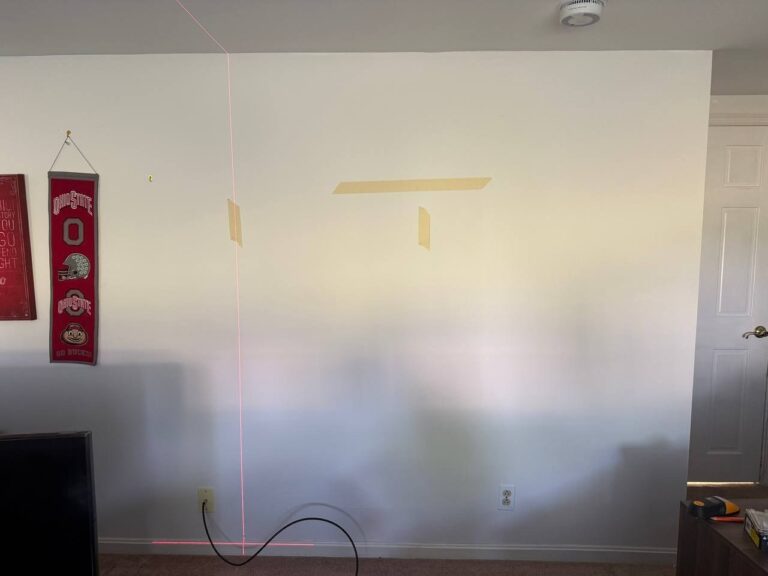
On this TV wall mount, the masking tape is already up and outlines where the screen will sit. The laser level throws a dead-level line across the wall, giving a reference that doesn’t depend on the ceiling, the floor or the trim. Ceilings and floors aren’t always true, so a line measured off them can drift across a wide screen.
A tape outline lets you do what a pencil mark doesn’t. You can step back, sit on the couch, and look at the actual footprint of the screen from where you’ll watch. If it reads too high, you peel the tape and move it. The drill comes out only after the height is checked from the couch and agreed on.
Why a TV Mount Fell Off the Wall: The Wall Decides, Not the TV
When a TV mount falls off the wall, the usual cause is a fastener that didn’t match the wall. It is rarely the TV or the bracket itself. This is mistake two.
The usual failures are easy to list:
- Lag screws that missed the stud.
- Plastic anchors in drywall holding a big screen.
- Screws driven into crumbling plaster.
- Hardware meant for wood driven into brick.
Each wall type needs its own approach:
- Drywall over studs means finding the studs, or using an anchor rated for the load.
- Plaster in older homes behaves differently. It is hard, it can crack around the hole, and it hides what’s behind it.
- Brick or concrete needs masonry anchors and a hammer drill.
For TV mounting in Philadelphia this matters a lot. In old rowhomes, the wall behind a TV, shelf or mirror is often brick or plaster, not drywall, and that calls for different hardware.
That’s why my rule is that the wall decides the price more than the TV size. Drywall is one job. Brick or concrete is different hardware and different time, and that means a surcharge right away: +$60–100 on the mount. So I ask about the wall before I name a number. Mount prices by screen size are on the TV mounting page.
| Wall type | What holds the mount | What goes wrong with the wrong hardware | Price impact |
|---|---|---|---|
| Drywall over studs | Lags into the studs, or an anchor rated for the load | Lags miss the stud; light plastic anchors pull out under a big screen | No wall surcharge |
| Plaster | Fasteners chosen for plaster and what’s behind it | Screws in crumbling plaster loosen and the mount sags or pulls free | No wall surcharge |
| Brick or concrete | Masonry anchors set with a hammer drill | Wood fasteners in brick never really grip | +$60–100 surcharge on the mount |
Cables Hanging Below the Screen: A Separate Job, Not an Add-On
Cables hanging below a mounted TV are a separate job from the mount. They should be priced that way from the start. This is mistake three: a perfectly level TV with a tangle of power and HDMI cords running down the wall.
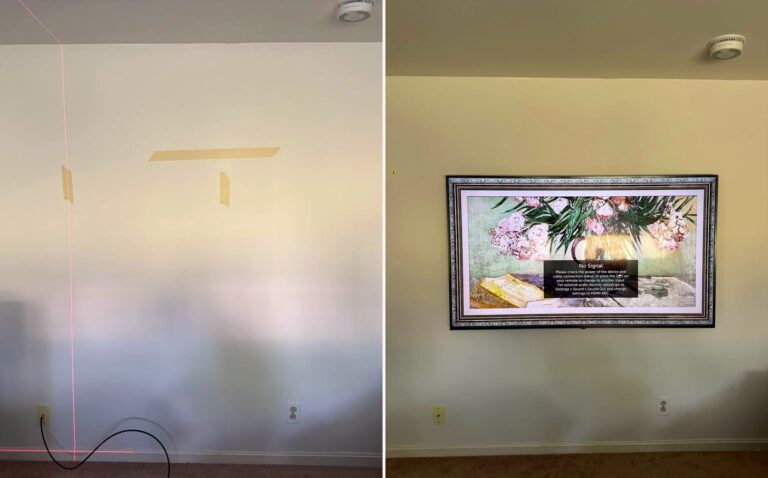
Here the TV sits dead level and the cables run inside the wall, with nothing left showing under the screen. That’s the finish to aim for. The work follows a general order: an opening goes in behind the TV and another near the bottom, and the cables are pulled through the cavity between them. It is not something done “while I’m at it.” It takes its own time and its own care.
So I say the price up front, so it doesn’t come as a surprise at the end. Running the cables inside the wall is +$90–150 on top of the mount.
The wall still has the last word here, the same as with the mount. Blocking inside the cavity, brick or old plaster can change the route, or decide whether an in-wall run works at all on that wall. When you send a photo for the TV, include the spot where the cables should go in and come out, and the cable run gets priced along with the rest of the job.
No Outlet Behind the TV: Where My Work Stops and an Electrician’s Starts
A missing outlet behind the TV is mistake four. You can spot it by a power cord stretched down to a low outlet or run along the baseboard. A cord like that undoes the clean look of the mount. A standard plug also pushes the TV away from the wall.
A recessed outlet behind the TV fixes both problems. The plug sits flush inside the box, so the TV can hang close to the wall and the cord disappears behind the screen. My price is $150–200, and it works only off an existing circuit.
Outlets and switches are replaced like for like, on the existing circuit.
Some jobs need a new circuit, panel work or wiring from scratch. That is an electrician’s job, not mine. If I see the work means getting into the wiring, I’ll say so honestly up front and send you to an electrician, rather than trying to work around it. Knowing where that line sits before the visit saves you a wasted appointment.
What to Do If Your TV Is Mounted Too High
If your TV is mounted too high, you have three real options: lower it, change the bracket, or leave it. Each one means something different for the wall.
- Lower it. Remount on the same bracket if the wall allows it. That means a new height and new holes, and the old holes get patched.
- Change the bracket. A tilt mount angles the screen down toward you. A pull-down or full-motion arm brings the screen lower and closer.
- Leave it. That’s a fair choice if the room limits you. Just know you’re trading neck comfort for not touching the wall.
Moving a TV leaves holes behind, and sometimes a lighter rectangle of paint where the screen used to shade the wall. So the patch and the paint touch-up belong in the same plan as the remount, not in a later visit. How well a touch-up blends depends on the wall and on how old the existing color is, which is worth keeping in mind when you plan the new height.
If the old mount left more damage than a few holes, or the whole wall needs fresh paint, see the drywall and plaster page and the painting page.
What a Finished Mount Should Look Like
A finished mount should read as part of the wall, not as a black box hung too high. The screen sits where your eyes land from the couch, square to the room and solid to the touch.
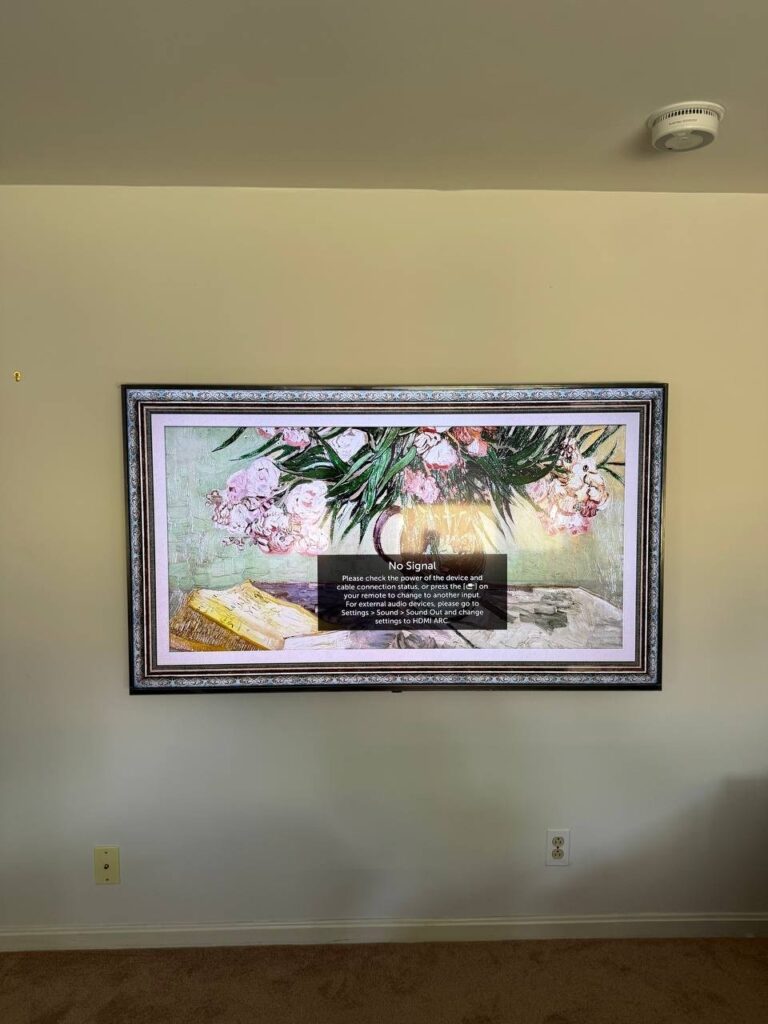
This TV is up on the wall and shows a framed painting on screen. When it isn’t playing anything, it hangs on the wall like a piece of art, which is the effect the right height for a TV makes possible. At eye level, a screen like this blends into the room. Hung near the ceiling, it would look like an afterthought.
Here is how one client put it in a Google review:
“I highly recommend this handyman! He mounted my TV on the wall, and the job was done perfectly. He was professional, punctual, and paid great attention to detail. Everything is secure, looks great, and he cleaned up after the work was finished. I would definitely hire him again!” — Yuliia Khmil, Google
I clean up after myself before I leave. It is part of the job, not a favor.
Getting a Price: Send a Photo of the Wall
A photo of the wall is how you get a firm number instead of a guess. Send a photo of the job and the price comes back the same day. Over the phone I give only a range. The number from the photo is the one I stick to, and I don’t change it once the work starts.
What to photograph before you send it:
- The wall where the TV goes, plus what it’s made of if you know (drywall, plaster, brick).
- The outlet, wherever it is now.
- The TV box or the bracket box, so the screen size and bracket type are clear.
- The spot where the cables should end up.
Prices are for labor — materials and hardware are separate. The bracket is usually yours, so you choose the one you want. If you need me to, I’ll buy it and bring the receipt. Details are on the price from a photo page and the TV mounting page.
Shelves, a mirror or a TV stand to assemble can go on the same visit. Hanging a shelf, picture or mirror is $50–90 per item.
Most of my work is in Northeast Philadelphia and the neighborhoods around it, from my base in Bustleton.
Call or text (267) 679-8533.
FAQ
- What to do if my TV is mounted too high?
You have three options. Remount it lower on the same bracket and patch the old holes. Switch to a tilt or pull-down bracket. Or leave it. Lowering it means new holes, so plan the drywall patch and paint touch-up for the same visit. Send a photo of the wall and the price comes back the same day.
- How high is too high for a TV to be mounted?
Sit relaxed and look straight ahead. If your eyes land below the bottom edge of the screen, it’s too high. A good rule of thumb is to put the screen center at seated eye level, about 40–44 inches from the floor for a typical sofa. Measure your own seat, because couches and people differ.
- Is it better for a TV to be too high or too low?
Slightly low is easier on the neck. Looking a little down is natural, and looking up for hours is not. A low TV only becomes a problem when furniture, a soundbar or people block the bottom of the screen. If the TV must sit higher, a tilt bracket cuts glare, but your eyes still go up.
- Why do people mount TVs too high?
Common reasons are simple. The height gets picked while standing, and standing eyes are well above sitting eyes. The TV goes wherever the wall is empty, or above a mantel. And the mark isn’t checked from the couch before drilling. Taping the screen outline on the wall first catches the mistake while it still costs nothing.
- Does a 55-inch TV go higher than a smaller one?
No. The screen center stays at about seated eye level whatever the size. A bigger screen just reaches further above and below that center line. Check that the bottom edge clears your furniture or soundbar, and that the top edge doesn’t force your eyes up from the couch.
- Why did my TV mount fall off the wall?
Usually the hardware didn’t match the wall. Common causes are lags that missed the stud, light plastic anchors in drywall, screws in crumbling plaster, or wood fasteners driven into brick. In older Philadelphia rowhomes the wall is often brick or plaster rather than drywall, and those walls need different fasteners.
- Can a TV be mounted on a brick wall in a rowhome?
Yes, with masonry anchors and a hammer drill. Brick or concrete takes different hardware and different time than drywall, so it adds a surcharge to the mount price. That’s why I ask what the wall is made of before I name a number. A photo of the wall usually answers it.
- Can you add an outlet behind the TV?
Yes. A recessed outlet behind the TV is $150–200, done off an existing circuit only. It lets the plug sit flush so the TV hangs close to the wall. If the job needs a new circuit, panel work or new wiring, that’s work for an electrician, and I’ll tell you so up front.